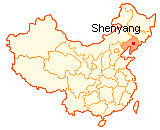
How can one write on a blog called "Life in the Middle Kingdom" from a metropolitan area in the United States? For those of you who may not be aware, "Middle Kingdom" is the direct translation of the Chinese term for China -- the Middle Kingdom of the world, the great nation whose neighbors would send emissaries to kowtow and pay honor to the Emperor and whose history goes back some five thousand years. Life in the Middle Kingdom is life in China... so for those of you who have been following my story can understand that this blog has been post-less for a year now.
And for those of you who haven't been following me, I have been in Washington DC for the past year, finishing up some coursework towards my masters degree in Asian Studies.
This, then, is the beginning of Chapter 2: The Return to the Middle Kingdom. Yes, next week I will be moving back to China. I am incredibly excited to return to the city I called home for a year, the place deep and long-lasting friendships were developed, the part of the world that has gotten into my blood and become a part of who I am.
For those of you who are interested, this blog will be the best way to keep track of me, hear about my adventures, and join me in this new Life in the Middle Kingdom.
Tuesday, June 22, 2010


Friday, May 29, 2009
"Happy Birthday" in a dozen languages
Okay, a dozen is probably over estimating how many languages people used this year to tell me happy birthday, but not by much. Chinese, Japanese, Portuguese, Creole, Swahili…
But instead of boring you with a list of languages, let me tell you about the most amazing birthday I could ever have asked for while living in a foreign country. The morning was pretty typical for me, although I did decide to skip my first two hours of class in order to call home. And we did have a pop quiz in the class I did go to, over material I hadn’t even looked at yet. Oops. But besides that, it was pretty normal.
After class, a friend from the Medical University had asked me to go down to his campus to help him with an application. So I headed off on an absolutely ridiculous attempt to take a bus to the Medical University. Let’s just say it normally takes 40 minutes, and this time it took more than twice that. But after finally realizing my normal bus choice has recently changed routes such that it no longer comes my way, then walking a while to find another bus going the right direction, standing on a crowded bus for far too long, managing somehow to get lost between where I got off and where I was headed (construction sites…), and getting soaked in the sprinklers that randomly decided to go off right when I was walking by, I made it there.
After a few minutes of “work” there at the school, we decided the weather was too perfect for sitting inside. So we headed down to a beautiful park along a river at the south side of the city. It was marvelous! It was the perfect opportunity to enjoy a surprisingly-not-so-full-of-Chinese-people park. We walked along the river a ways, happened upon the damn upstream that we didn’t know about, and played badminton for a while on an amazingly green lawn.
I had no plans for the evening, so was more than willing to spend plenty of time enjoying the park and the perfect weather. However, the guy I was with insisted that he had to be back to his room at 6:00 for something. So at the appropriate time we made our way back to campus. (Not my campus, but the Medical campus. A significant portion of my friends here are from the Medical University and not from my school, so I spend a good deal of time down there.) To my great surprise, the “thing” at 6:00 was a party for me!
I was really impressed that they actually managed to keep the event a surprise to me, especially when I found out that several of the others were also surprised to find out it was a surprise! But they managed, and I was indeed not expecting such a thing. But I have to admit that the whole day made me feel so loved and feel so much belonging among these people.
The party itself was way better than just a typical birthday party, because it started with a time of singing my favorite kind of songs and some sharing from my favorite book, and then they all asked our Father on my behalf. What an encouragement! But of course, the party would only have been a fellowship if it had ended there. So that was followed by lots of delicious fruit, some delivered Chinese food, and even a cake. (By the way, turns out it really is the thought that counts. Somehow the cake really did taste pretty good, since it was from my friends who cared enough to get it for me, even though it was one of those typical Chinese cakes that really can’t compare to anything back home.) The food, though, had nothing on the other activities of the night. Among the eight of us there, we represented seven countries. Of those seven countries, six of them were in Africa. (Hint: I’m from the U.S., which is not in Africa.) So someone grabbed a guitar and started playing some African P&W songs that I have learned over the course of this year. African songs are very energetic and just make you want to dance. So six of us (minus the guitar player and the cameraman) squeezed into the open half of the one dorm room and danced: South African dancing, Tanzanian dancing, etc. And all to music that is uplifting and encouraging. How fun!
However, six sweaty people in a (small) dorm room with no air soon turned into a hot, sticky mess. After we were too hot and tired to go on (or was it that they ran out of African P&W songs that I know?), we decided to watch a movie. It was a really interesting experience for me, though, to sit with 7 Africans and watch a movie about African Americans. We had an interesting discussion afterwards about that.
Soon enough, midnight rolled around and it was no longer my birthday. At least not in China. So we all headed back to our homes (a.k.a. dorms) and slept well. (I slept well, anyway. I was worn out after all the unexpected excitement of the day!) But I went home that night feeling very special, very loved, and very much excited about the year that is to come.
Thursday, May 7, 2009
You may now kiss the bride
No, don’t worry, I wasn’t the bride. But I did get to see a traditional (Northeast China) Chinese wedding last week! A Chinese friend of mine had an invitation to go to this wedding, because the bride’s mom and his mom are coworkers. But he didn’t know the bride or groom or really anyone else there besides his parents. So he invited me to go along! Of course, I jumped at the chance.
Keeping in mind that China is huge, and so the traditions are pretty diverse in the different areas, I will now go about trying to explain to you what a traditional Northeast China Chinese wedding is like. Difference from the U.S. number 1: Starting time. I had to meet my friend in a different area of the city at 6:30 a.m. Whoa. Didn’t really know that when I jumped at the chance to go. I might not have jumped quite so high if I had realized how early I was going to have to get up. But anyway. So we met about 6:30 a.m. and walked together to the bride’s parents’ house (read: apartment). The bride was there, in her beautiful white dress, getting her hair done. All the guests who were there for the bride were there. Of course, Chinese apartments are not large, so the vast majority of us were actually several stories lower, waiting outside the apartment building. And that’s pretty much what we did: waited. I met some Chinese people who were incredibly surprised to see a foreigner show up. But they all seemed to be tickled to have a foreigner, especially the mother of the bride. She liked me a lot.
Meanwhile, all the guests for the groom were apparently gathering at the apartment that the new couple will be moving in to. The groom and some of his friends had to drive to the girl’s place to go pick her up. This comes from the tradition of a girl being taken away from her own family and joining the groom’s family, although now the “new” residence is actually just for the couple and not the groom’s parents’ place. The groom arrived around 8 a.m. (an hour later than he was expected…) Apparently tradition has it that the bride’s family and friends have to resist the groom before letting him take her away. So the girl by then was sitting on a bed with the bedroom door closed and locked. The groom showed up, and knocked on the bedroom door (since the door to the apartment itself was standing wide open and he had walked right in). “Who is it?” “What do you want?” “No, you can’t come in!” It was fun to watch the bickering back and forth between the bride’s friends and the groom, of course knowing full well that he would eventually be let in. And when he was, the random foreigner was also pushed into the room to be able to see what was going on. Sometimes it’s really convenient to be a foreigner!

In the room, the groom presented the bride with some flowers and asked her to go with him. First she refused, but he managed to convince her. :) Then they had to eat some really really long noodles, symbolizing long life, and eggs, symbolizing fertility.

From there, the groom had to carry a shoeless bride down the several flights of stairs and out to the car waiting outside. In the car, he put her shoes on her. I’m not really sure why she wasn’t allowed to wear shoes out to the car, but apparently that’s the tradition. Maybe it has something to do with when Chinese women had really little feet from binding them, but I don’t know.
While that was going on, the rest of us quickly ran off and climbed into the cars lined up outside, waiting to take us all to the next stop…

Following custom, the groom took his new bride to their new house. Of course, all of us guests of the bride went, too. Upon arrival, the groom’s guests and parents were waiting to welcome the couple with firecrackers (a staple at any happy event in China). The couple went upstairs to the apartment and took some pictures, while the guests were allowed to go in and see the place as well.
I was a little surprised at this point, to realize that we had spent about half an hour being transported up to the new apartment, just to spend about fifteen minutes there. But apparently that’s the tradition. So I just followed my friend back out to the cars, waiting to take us away again, this time to go to the restaurant where the main part of the reception would be held.
Everything that was familiar to me about this wedding was done at the restaurant. The couple came in and walked down an “aisle” in the big hall. Of course there was no pastor, but there was a cheesy MC who apparently has the authority to marry people. But only if he also can entertain the guests. So he would randomly sing weird songs for us and try telling jokes. Perhaps they would have been funnier if I had understood any of them, but whatever. I was just struck by the way China really has no concept of formal, elegant, or classic tastes. During the “ceremony” part of at the restaurant, there was a strobe light going, and the music was mostly oldies love songs. Except the electro version of Canon in D. That was entertaining. Even the way the guests dressed proves the lack of taste: no kidding, there was someone wearing an Adidas track suit. Most people were wearing jeans or any sort of regular daily clothes. Anyway.


The part at the restaurant that resembled the wedding ceremony in the U.S. included some vows, the kiss, the rings, etc. In addition to those things, it also included what reminded me of a Unity Candle… except that they lit a firecracker or sparkler thing instead of a normal candle! And at first I thought it had no religious significance, until they stood back and reverently put their hands together, waiting until the firecracker went out. I didn’t get a very clear explanation about the background of that, so I can’t pass any information along. Sorry.
The couple also had to kowtow (bow) to the parents and to each other, showing respect and reverence. Then they greeted each of the parents, called them Mom and Dad (for the first time – it’s Aunt and Uncle until then), and were presented with red envelopes. Red envelopes are a wedding tradition all across China as far as I know; instead of guests bringing gifts for the new couple, they all come with a red envelope with money inside. Usually the smallest amount would be 200 kuai, something like $30 (although compared to the cost of living, something much more along the lines of $100+). Another perk of being a foreigner: I was told not to bring a red envelope.
After the “ceremony” part at the restaurant, we had what I compared to a regular wedding reception in the U.S. There was tons of food, served Chinese style, of course. Most of the food was meat, which is more expensive so must be served to appear wealthy. The groom’s family is actually the host of this meal, though, and to my surprise doesn’t even get to sit down or eat this food. They were just wandering around the venue talking with people and making the bride’s guests and family feel welcome. The new couple also wandered around, of course, most notably to light a cigarette for every male and any female who smokes, and to give a little trinket to everyone else. Thankfully, I fell into the “everyone else” category.

This picture is simply to prove that I was actually at the wedding. I don’t want you to think that I just got some pictures from the internet and made up all this information for fun. Nope, I was there. The guy wearing the tastefully-chosen blue hoodie and jeans is my friend.
It’s impolite at a Chinese wedding to leave before the bride and groom. But since the whole event started so ridiculously early in the morning, we were out of the restaurant and heading off to our next activities by noon. Wow, what a morning!
Keeping in mind that China is huge, and so the traditions are pretty diverse in the different areas, I will now go about trying to explain to you what a traditional Northeast China Chinese wedding is like. Difference from the U.S. number 1: Starting time. I had to meet my friend in a different area of the city at 6:30 a.m. Whoa. Didn’t really know that when I jumped at the chance to go. I might not have jumped quite so high if I had realized how early I was going to have to get up. But anyway. So we met about 6:30 a.m. and walked together to the bride’s parents’ house (read: apartment). The bride was there, in her beautiful white dress, getting her hair done. All the guests who were there for the bride were there. Of course, Chinese apartments are not large, so the vast majority of us were actually several stories lower, waiting outside the apartment building. And that’s pretty much what we did: waited. I met some Chinese people who were incredibly surprised to see a foreigner show up. But they all seemed to be tickled to have a foreigner, especially the mother of the bride. She liked me a lot.
Meanwhile, all the guests for the groom were apparently gathering at the apartment that the new couple will be moving in to. The groom and some of his friends had to drive to the girl’s place to go pick her up. This comes from the tradition of a girl being taken away from her own family and joining the groom’s family, although now the “new” residence is actually just for the couple and not the groom’s parents’ place. The groom arrived around 8 a.m. (an hour later than he was expected…) Apparently tradition has it that the bride’s family and friends have to resist the groom before letting him take her away. So the girl by then was sitting on a bed with the bedroom door closed and locked. The groom showed up, and knocked on the bedroom door (since the door to the apartment itself was standing wide open and he had walked right in). “Who is it?” “What do you want?” “No, you can’t come in!” It was fun to watch the bickering back and forth between the bride’s friends and the groom, of course knowing full well that he would eventually be let in. And when he was, the random foreigner was also pushed into the room to be able to see what was going on. Sometimes it’s really convenient to be a foreigner!

In the room, the groom presented the bride with some flowers and asked her to go with him. First she refused, but he managed to convince her. :) Then they had to eat some really really long noodles, symbolizing long life, and eggs, symbolizing fertility.

From there, the groom had to carry a shoeless bride down the several flights of stairs and out to the car waiting outside. In the car, he put her shoes on her. I’m not really sure why she wasn’t allowed to wear shoes out to the car, but apparently that’s the tradition. Maybe it has something to do with when Chinese women had really little feet from binding them, but I don’t know.
While that was going on, the rest of us quickly ran off and climbed into the cars lined up outside, waiting to take us all to the next stop…

Following custom, the groom took his new bride to their new house. Of course, all of us guests of the bride went, too. Upon arrival, the groom’s guests and parents were waiting to welcome the couple with firecrackers (a staple at any happy event in China). The couple went upstairs to the apartment and took some pictures, while the guests were allowed to go in and see the place as well.
I was a little surprised at this point, to realize that we had spent about half an hour being transported up to the new apartment, just to spend about fifteen minutes there. But apparently that’s the tradition. So I just followed my friend back out to the cars, waiting to take us away again, this time to go to the restaurant where the main part of the reception would be held.
Everything that was familiar to me about this wedding was done at the restaurant. The couple came in and walked down an “aisle” in the big hall. Of course there was no pastor, but there was a cheesy MC who apparently has the authority to marry people. But only if he also can entertain the guests. So he would randomly sing weird songs for us and try telling jokes. Perhaps they would have been funnier if I had understood any of them, but whatever. I was just struck by the way China really has no concept of formal, elegant, or classic tastes. During the “ceremony” part of at the restaurant, there was a strobe light going, and the music was mostly oldies love songs. Except the electro version of Canon in D. That was entertaining. Even the way the guests dressed proves the lack of taste: no kidding, there was someone wearing an Adidas track suit. Most people were wearing jeans or any sort of regular daily clothes. Anyway.


The part at the restaurant that resembled the wedding ceremony in the U.S. included some vows, the kiss, the rings, etc. In addition to those things, it also included what reminded me of a Unity Candle… except that they lit a firecracker or sparkler thing instead of a normal candle! And at first I thought it had no religious significance, until they stood back and reverently put their hands together, waiting until the firecracker went out. I didn’t get a very clear explanation about the background of that, so I can’t pass any information along. Sorry.
The couple also had to kowtow (bow) to the parents and to each other, showing respect and reverence. Then they greeted each of the parents, called them Mom and Dad (for the first time – it’s Aunt and Uncle until then), and were presented with red envelopes. Red envelopes are a wedding tradition all across China as far as I know; instead of guests bringing gifts for the new couple, they all come with a red envelope with money inside. Usually the smallest amount would be 200 kuai, something like $30 (although compared to the cost of living, something much more along the lines of $100+). Another perk of being a foreigner: I was told not to bring a red envelope.
After the “ceremony” part at the restaurant, we had what I compared to a regular wedding reception in the U.S. There was tons of food, served Chinese style, of course. Most of the food was meat, which is more expensive so must be served to appear wealthy. The groom’s family is actually the host of this meal, though, and to my surprise doesn’t even get to sit down or eat this food. They were just wandering around the venue talking with people and making the bride’s guests and family feel welcome. The new couple also wandered around, of course, most notably to light a cigarette for every male and any female who smokes, and to give a little trinket to everyone else. Thankfully, I fell into the “everyone else” category.

This picture is simply to prove that I was actually at the wedding. I don’t want you to think that I just got some pictures from the internet and made up all this information for fun. Nope, I was there. The guy wearing the tastefully-chosen blue hoodie and jeans is my friend.
It’s impolite at a Chinese wedding to leave before the bride and groom. But since the whole event started so ridiculously early in the morning, we were out of the restaurant and heading off to our next activities by noon. Wow, what a morning!
My oldest friends in China
Last week, I had the really interesting opportunity to visit a Chinese elderly home. The students from my fellowship organized a day of outreach to various places around the city: two elderly homes, an orphanage, and several *thinking in the upward direction* walks. Twelve of us went to the one elderly home, which happens to be a Buddhist place. Obviously, proselytizing wasn’t so much on the list of kosher things to do while there, although I know there were some good conversations being had nevertheless.
All together, our group saw between 120 and 150 people, and we brought little gifts for each one. (Most of the gift bags had a pair of socks and a little bar of soap, so it was fairly practical and versatile.) I was paired up with a guy from Nigeria who only speaks a few words of Chinese, which meant I was really the one to do most of the communicating. It’s really entertaining to try to talk in a foreign language with old people! But the two of us first went down the hall with probably the sickest people in the facility (most of them bedridden). We finished pretty quickly, since the vast majority of them couldn’t hear, couldn’t speak, or couldn’t do either. That made for pretty limited conversations, regardless of my Chinese ability. :) But it was amazing to see how much a genuine smile can communicate and how touched some of them were.
The first lady I met was a hundred years old and has been living there for twenty years! What an interesting life. She was actually quite healthy, at least for being a hundred, so she was sitting up and perfectly capable of communicating with us. The biggest problem with her was that she was still so mentally sharp, she didn’t really care to slow down enough for the foreigners. But we did talk a little about her large collection of Buddhist books that she’s been reading, as well as the vast changes that have taken place in China during her lifetime.
Later on, I had the opportunity to meet the oldest person in the facility: a 103-year-old gentleman. He was also sitting up and somewhat communicative, although he slurred his speech a lot more, which made it difficult for me. (Remember, this was all in Chinese. People this old mostly didn’t ever have the opportunity to study English. If they’ve studied a foreign language, it would have been Japanese or Russian.) But he was eager to take pictures with all the foreigners who had come to see him, and it was fun to talk as much as we could.
My favorite lady at the place was a bit younger: 97. But to my great surprise, she was very active and spunky. She and I walked around together a bit, until she told me that I should sit down since my legs were probably getting tired. I told her that I would only sit down if she sat down with me. :) But we talked at some length. She asked me if I missed my mom, and how long it’s been since I’ve seen her. In a sort of sorrowful voice, she advised me that “your mom misses you, even if you don’t miss her.” While I assured her that I do actually miss my mom, I realized that her comments really had nothing to do with me. She was missing her own children. And that’s hard to see, that this lively lady has been living in this facility for some time now because her children won’t take her in (or even visit her there, probably). It was interesting to hear her story, and to reflect on how her story fits into the larger culture here.
But I’ll stop here on this topic for now. I’d be happy to share more about my reflections of the larger culture/society and the role of the elderly homes with any of you who are interested. Just ask me after I get back to the U.S. :)
Monday, April 20, 2009
long johns, citrus fruits, and other random things
Putting on my long johns in November was acceptable. December was logical. January was appropriate. February was expected. Putting on two pairs at once in March was a little less than thrilling, but I could deal. But come on now, putting on long johns in the second half of April?! This is truly getting ridiculous…
The Chinese concept of “late” and “early” is a bit different than most of us Westerners. True enough, at least a few of the Chinese authorities understand that to a small extent. We in the foreign student building don’t have a 10:30 curfew like the Chinese dorms. Ours is 11:00.
What really surprised me, though, was the day I was walking away from campus at 6:45 p.m. I happened to run into a Chinese girl I know, who also lives at my school, and so we smiled and greeted each other. But to my surprise, she then – very animatedly – told me, “Be careful! What are you doing going out so late?!” Really? 6:45 is late? Wow. If those Chinese students only knew how active the foreign student building is at night…
One of the more entertaining moments in my Chinese class recently was when we were talking about the possibility of repeated names. In the U.S., repeated first names are quite common, but to meet someone with the exact same name, first, middle, and last, is not so common. In China, however, there are a lot more people and a lot fewer names, which leads to a lot more people with identical names. Here was the sentence from our text (in translated form, of course): “Even if you name your child ‘Big Cow,’ you’re still bound to run into people with the same name.” Wow, that’s really unfortunate!
Growing up I always thought there were four kinds of citrus fruits: oranges, lemons, limes, and grapefruits. Turns out there are whole lot more than that. (Of course, I know about tangerines, clementines, pomelos, and the like. But there are a lot more than that, too!) My newest discovery of a citrus fruit involved a little orange thing that looks almost identical to a grape tomato (except orange, not red). I had seen a lot of Chinese people buy bags of these little guys, so I thought I should try my hand at it as well. Next stop at the fruit stand, and I bought myself some little orange grape tomato things.
Having never seen anyone actually eat one of these before (only seeing people carry them home to eat there), I got home myself and just assumed I could figure out what to do. I mean really, it’s a citrus fruit. How hard can it be? So I washed a couple, grabbed my garbage can, and started peeling. Uh-oh. Why won’t the peel come off? I very awkwardly peeled off this peel that was hardly different than the fruit itself, and then popped what I considered must be the fruit into my mouth.
Turned out to be mostly seeds. Yikes. The flavour was good, but it was the messiest little citrus fruit I’ve ever tried eating. And the inside had so many seeds, there was hardly any fruit to eat! (Think about it, the size of a grape tomato, with about 6~8 seeds the size of regular orange seeds. That doesn’t leave much room.) A little disappointed, I went ahead to try another one… maybe the first was just a fluke.
Nope. Just as messy and just as little fruit. Darn it.
That happened to be right before I was having a bunch of people over for lunch, so I decided to put them out and see if anyone else knew how to eat them. Given how many Chinese I’ve seen buying whole bunches of this little fruit, I figured I must be doing something inefficiently. There must be a better way to eat this fruit.
Well, none of the foreigners who came that day had any idea either. So those little fruits sat on my table for a few days, got moldy, and I threw them away disappointedly. Oh well. You win some, you lose some.
A couple weeks later, I invited a Chinese girl to come to my room for something. In good Chinese fashion, she brought me a gift… You guessed it, these little orange grape tomato fruits. Unfortunately, she didn’t stay long enough for me to offer her some and then study how she ate them! Alas, my only potential teacher left and I was there alone with these fruits who had already conquered me once.
But fear not! My trusty American friend came over the next day. To my great surprise, of all the people in Shenyang (including those 8 million Chinese ones), the only person who could actually teach me to each these little guys was an American! She walked into my room, saw the fruits on my table, and was excited because she likes them. I admitted the whole story to her, and she laughed hysterically. I decided to laugh too, because I figured it was better for her to laugh with me than at me. But finally, she admitted of her own adventures in learning to eat this fruit, and she gave me a good orange grape tomato fruit eating lesson.
In case any of you ever have opportunity to try one of these strange little orange grape tomato fruits, let me give you a brief lesson. I wouldn’t want you to be conquered by them the way I was. It’s pretty humiliating for a fruit to outsmart you. So here’s what you do: Grab one of those little guys, and wash it nice and good. (Don’t you love my English abilities these days?) Then just bite it! Peel and all, just eat it! (Spit out the seeds, of course.)
I had no idea there were citrus fruits that are just eaten with the entire peel, but apparently there are. And they’ll get you if you don’t know that.
I also had no idea those little guys were worth so much space on my blog…
Tuesday, April 14, 2009
Exciting Tombs
“Happy Easter!” I say to the deskie in my dorm. (Of course, I didn’t really say “happy Easter,” but rather the Chinese equivalent.) “Happy what?” And the conversation continued, just as it had with every other Chinese person I had talked to that day. “Easter.” “Oh, we don’t have that holiday.”
It was a neat opportunity to share with a variety of Chinese what this random holiday that they know Americans celebrate is actually all about. One day, I certainly hope they stop saying that they don’t have that holiday. I hope they realize it’s the most important holiday of them all, and it’s for them, too.
But the Chinese have a different holiday (completely unrelated in the Chinese mind except in time of year). A week ago, they celebrated “Tomb-sweeping Day,” as it has been translated. The literal translation is actually “clear & bright holiday,” but that doesn’t help us poor foreigners understand anything about the day, so Tomb-sweeping Day is a more convenient name. Traditionally, it’s a day to pay respects to the dead. Nowadays, while they still do that, it seems to also be a sort of national Spring Cleaning Day. Haha! But hey, three days off is three days off… except, of course, when you’re in China and they consider a Saturday-Sunday-Monday holiday to be three days off. Let’s be realistic here, that’s only one day out of class!
Figuring I should probably honor this my first experience of Tomb-Sweeping Day in some way, but having no dead relatives buried here in China to go visit, I decided to go to the park. The park does happen to be for a dead person – some important person from the Qing dynasty, although he never actually was the emperor. And that important person (who’s name I can’t remember at the moment… obviously, he was very dear to my heart) is buried in a huge tomb in the park, with impressive buildings and walls around the area. The main part of the park costs 6 kuai to get in (about a dollar); the tomb area, with the walls, buildings, and a big mound of dirt that is supposedly his tomb, costs an extra 30 kuai. Clearly, the main part of the park was all the more I needed to see… but Chinese will be Chinese. The first day I went, I was with a Chinese friend. He wanted to make sure I saw the “highlight” of the park, which happens to be that large mound of dirt, so I had to pay the extra 30 kuai. Convenient.
That’s why the second and third times I went to the same park during our three day holiday I went with foreigners. They had enough sense to not pay 5 bucks for a mound of dirt.
The most entertaining trip, though, had to have been the last one. We were just hanging out in the park in the evening, after dinner. In fact, my trips got cheaper each time, because the last time we didn’t go until after 6 p.m., so the 6 kuai part was actually free. Woot! But yeah, we were just hanging out, talking, wandering around the largest non-built-up, relatively natural looking area of land for kilometers. (Wow, that just doesn’t sound the same to say “kilometers” there instead of “miles.”) What we didn’t know… oops… was that the park actually closes, and the gates lock, at 10 p.m. Hehe. We happened to still be inside at that point, and no where near the gates to realize that they were being locked. Yeah, it was quite the surprise when we finally decided we were cold and ready to go home and… we couldn’t get out.
Climbing over the wall seemed like a good idea at first, but then we realized how high and smooth the walls were, making them superbly difficult to climb. So we wandered around a bit to see if there might be another gate. That didn’t work either; we just got lost. (It’s actually a surprisingly big park.) Thankfully, in our wanderings we happened upon another lost soul, so we stopped him and asked how we could get out. He pointed us to the security office, but said he couldn’t go with us. What that gentleman was doing there that he didn’t want the security guys to know about, I have no idea. I’m just grateful he was there to assist us.
Sure enough, the security office had guards inside. They were surprised when someone knocked on the door inside the park, and then were even more surprised when it was foreigners knocking. They weren’t particularly thrilled to see us, but we just threw in a nice 不好意思!(I’m embarrassed), which is the most amazing phrase in all of Chinese. If said with the right facial expressions, this phrase can get a foreigner out of just about any potentially bad situation.
And it worked that night. They let us walk through the office to the outside world, and we were home-free. Whew.
Friday, April 3, 2009
Not all learning comes from a book
The first month of the spring semester in China has just ended, so it seems like a good time to do a little reflection. What have I learned? While my vocabulary might not have improved as much as I had hoped, and my pronunciation seems more or less the same in my mind, I certainly have plenty of stories and thoughts to share from this month of class.
Though none of my classmates would ever admit to it, I think the best class we have this semester might very well be our Chinese Culture class. The reason no one would admit it is because the good thing about the class has nothing to do with the subject he lectures on or how interesting it is. Admittedly, most of us are really struggling to stay awake at 8:30 Wednesday morning when we get into that room and start hearing our teacher’s impressively monotone voice (impressive because Chinese is a tonal language). But this is why I say it’s a good class: we are learning first-hand what the Chinese education system is like. We walk into class, sit down, take out paper, and take notes quietly for an hour and a half as the teacher talks. He never stops. He never slows down. He just talks. He tells us what we should know, and it is our job to learn it. Sure, I’ve learned a few interesting bits of information from the content of his lectures, but mostly I’m not too terribly interested in studying the elevation changes across China or the names of all the different changes the Chinese characters have gone through in the past several thousand years. But I’ve learned a lot from his approach, understanding that he is a typical older Chinese gentleman who only knows one method of education (even when his students hardly speak Chinese!).
The one interesting topic our Culture teacher discussed was about the 56 ethnic groups in China. Having studied this country for several years already, I obviously already knew some of what he talked about, but I was struck by his representation of the relationship between the Han Chinese (the majority group, constituting appr. 92% of the whole population) and the 55 minority groups, and the importance of the issue at the national level. According to our book, the 8% of the population that is of minority descent controls/lives on nearly 64% of the total land in China, leaving only 36% of China to the other 92% of the population. Furthermore, the 36% that the Han live on is primarily in the Beijing-to-Shanghai area, leaving the minority groups to live on the periphery. All of a sudden, I understand why the government has established so many laws that favor the minorities.
I have the same teacher for my Watching Movies class at the end of the week. (Okay, okay, the literal translation of the course name is “Watch, Listen, Speak,” but really it’s just a watching movies class. Woo-hoo!) Most of the time we’re just watching Zhang Yimo movies (he’s a famous Chinese director), but of course our teacher enjoys lecturing so sometimes gets off on various tangents about the movies. I was particularly tickled the other day when he started giving us some photography lessons based on the cinematography of the movie. How bizarre to think I could understand someone talking about such things in Chinese!
My Speaking class is what we call “ma ma hu hu” in Chinese. Literally translated, that’s “horse horse tiger tiger,” but that obviously doesn’t make any sense. It just means so-so. Mediocre. Ma ma hu hu. The problem in my speaking class is that the teacher doesn’t like when we speak. At least, she doesn’t like when we speak our own things, when we don’t just use the exact sentences that are in the book. Seriously, our homework this weekend is to memorize one of the texts, word for word. Because clearly, being able to recite three unknown individual’s perspectives on the internet is going to come in handy one of these days. (Sense the sarcasm…) But that’s just one of those “Chinese approach to education” things. The most bizarre of our speaking classes so far, though, was the day we were talking about the problems related to aging populations (for the up-teenth day in a row) and she brought in a song related to the topic. Not only did she manage to find a song about such a thing, but she brought it in and made us sing it out loud together. Talk about an awkward class!
My favorite class, and hands-down the best class in terms of content and teacher, is my Writing class. Every week I have to write an essay in Chinese (400+ characters, which is maybe like a 200 word essay in English? So not too long). It’s been a really good opportunity to get some feedback on writing style and structure, besides being good to get back into the habit of organizing and writing essays. But I really had to laugh to myself the night I had to avoid going out and experiencing China in order to stay in my room and write an essay about alligators. What a strange experience, to write an essay in Chinese explaining to my teacher and classmates how to get away from an alligator if they are ever being attacked by one. Because, of course, that’s likely to happen around here!
A few other random things I’ve learned from class this month: There are 100 million people in China with the last name “Li” (Lee). Traditional Chinese music only has the five notes, do, re, mi, so, and la. I learned the Chinese term for unrequited love, which is a term I’m not even sure I know how to use in English. For some reason, using liquid laundry detergent is supposedly better for the environment than using powdered (I just don’t know why). And finally, the cause of every problem in China can be understood by one simple sentence: 人太多!(“ren tai duo!” – Too many people!)
Really, my Belgian friend and I have started counting every time we hear that claim as an excuse/cause for some situation, and to date, every single one of my teachers has used it at least once. There was one day I heard it 4 times before noon.
Subscribe to:
Posts (Atom)